
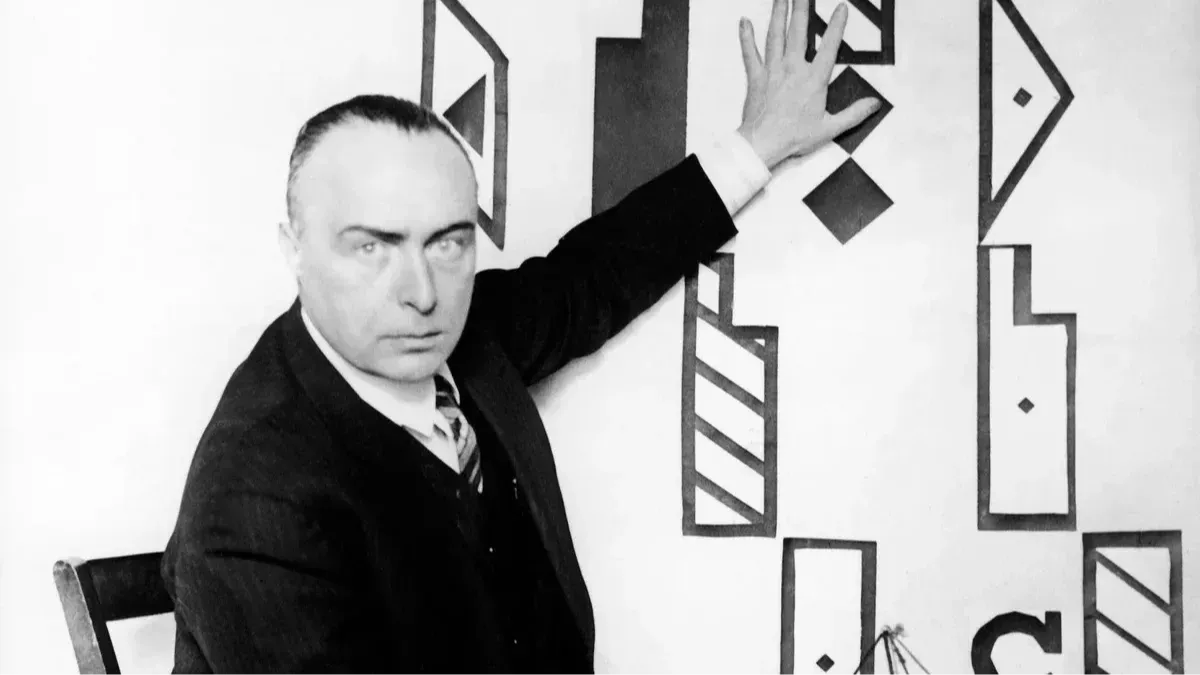
Rudolf Laban
Rudolf Laban (1879-1958) was born in Austria-Hungary. As a dance theorist and visionary teacher and thinker, he evolved human motion studies that eventually provided the intellectual foundation for the development of central European modern dance. His work extended to his most celebrated collaborators, Mary Wigman, Kurt Jooss and Sigurd Leeder. Laban raised the status of dance as an art form at the time, and his exploration into the theory and practice of dance and movement transformed the nature of dance scholarship. Laban fled Nazi Germany in 1938, eventually settling in UK.
Dedicating his life to the study of human movement, Laban developed a comprehensive analytica language for movement as a framework for observing, describing, and interpreting human movement. Known today as Laban/Bartenieff Movement Analysis (LMA), it is a method of seeing, describing, experiencing, and organizing movement for the purpose of increasing personal awareness, movement efficiency, and the range of physical movement choices and possibilities in our everyday lives. The degree to which we are aware of and understand our physical and emotional life informs the clarity of our movement and self-expression. Laban saw that the quality, style, and dynamics of one’s body movement reflect the inner attitudes and feelings (body attitude) an individual has about him or herself and about being in the world. Personal filters, preferences, biases, trauma and ways of being in the world create a myriad of harmonious and conflicting experiences.
Laban also became known for his invention of a system of dance notation, originally called also Kinetography. A formal system of abstract geometric symbols, Labanotation is used to record movement on a vertical staff, much like musical notation for music. It is a precise documentation tool for dance choreographies, as well as generative tool of movement possibilities that describes human movement using symbols based on specific movement theories and principles. It can be used within the broader framework of LMA, but is a separate system.
Today, the vast material of Laban/Bartenieff Movement Analysis (LMA) is organized into four categories referred to as BESS: Body, Effort, Shape and Space. The Body category draws on the disciplines of anatomy, kinesiology, and sensory-motor development to address how our body is designed to move both functionally and expressively, as our instrument of perception and expression. The Effort category is about how we exert ourselves physically, as an expression of our inner attitude towards ourselves, a task, activity or movement. The Shape category investigates how we connect, or don’t connect with our environment and other people, as expressed in how we shape our bodies and posture during movement and interrelationships. The Space category optimizes how we can use space to evolve a fuller use of our three-dimensional movement potential.

Photography of Movement Choirs by Rudolf Laban, part of a National Gallery exhibit on Sigmund and Carl Jung, Zurick, Switzerland, October 2025
LMA analyzes the qualitative and structural aspects of movement and can be applied in many fields beyond dance, such as psychotherapy, conflict resolution, acting, business consulting and cross-cultural analysis. Laban was one of the first persons to develop community-dance and to set out to reform the role of dance education, emphasising his belief that movement study should be made available to everyone, and the first line of learning before specializing in any other training.
More on Rudolf Laban
https://labanlibrary.wordpress.com/2016/03/30/what-was-rudolf-laban-like/
Be In Touch!
Join Danielle's email list to be the first to know about exciting news and updates.